
In how many ways can you paint the tiles?
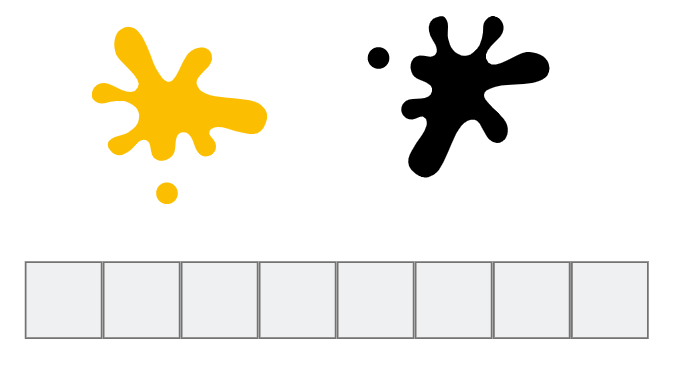
On a shelf, there are 8 tiles which need to be painted. We have 2 colours, yellow and black.
In how many way can we paint the tiles such that no two consecutive tiles have the colour black?
Some examples : Not Allowed

Some examples : Allowed
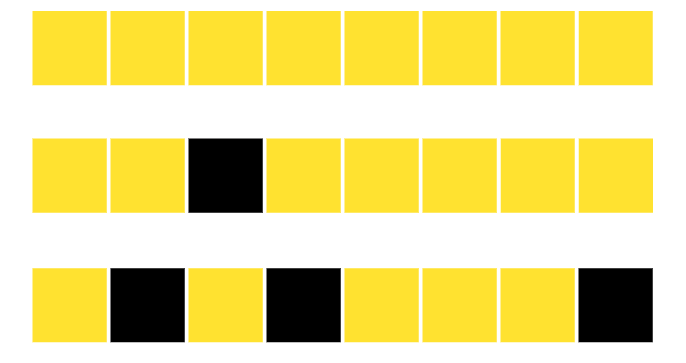
Above are some ways of painting the tiles. How many total different ways are there?
What if there were just 4 tiles, or 5 tiles? What if there were 100 tiles? How would go about finding the answers.
Post your thoughts and ideas in the comments. Please try accompany your answers with explanations.
Update: Many readers have responded via Email and Messages. The starkly different approaches and ways of thinking have been discussed here!
Note to parents and teachers: This problem is suitable for all ages 10+. We need to introduce children to problems that make them think, and dive into ideas. You just need to be comfortable with them exploring, experimenting, struggling and trying different approaches. Contact us if you need resources for this task for your classroom or home.
What students worked out9
Student 64
Required Numbers = All white tiles(8C0=1)+ one black & remaining white tiles(8C1=8)+ two blacks & remaining whites
(8C2-7C1=28-7=21)+Three blacks & remaining whites(8C3-6C1=56-6=50)+ Four Blacks & remaing whites (8C4-5C1=70-5=65)=1+8+21+50+65=126Student 16
The above solution needs Modification.:
Required Numbers = All white tiles(8C0=1)+ one black & remaining white tiles(8C1=8)+ two blacks & remaining whites
(8C2-7C1=28-7=21)+Three blacks & remaining whites(8C3-6C1-(5+4+3+2+1)*2=56-6-30=20)+ Four Blacks & remaing whites (2)=1+8+21+20+2=52Student 16
Another way:
1 with no black+8 with one black+(6+5+4+3+2+1) with two blacks+{(4+3+2+1)+(3+2+1)+(2+1)+(1)} with three blacks+2 with four blacks=1+8+21+20+2=52
Karanteacher
Wow! Loved the way you are thinking about different ways to approach the same problem! However, I would suggest you to think again about the case with 4 blacks. Do you think you might have missed out a few cases.
Student 16
yes you are right. I missed some for with 4 blacks
blacks can take positions from say left to right:
1st; 3 rd; 5 th & 7th positions ;
1 st; 3rd; 5th & 8 th positions;
1 st;4th; 6 th & 8 th positions;
2 nd; 4 th; 6 th &8 th positions
Hence correct solution:
1 with no black+8 with one black+(6+5+4+3+2+1) with two blacks+{(4+3+2+1)+(3+2+1)+(2+1)+(1)} with three blacks+4 with four blacks=1+8+21+20+4=54
Student 16
yes you are right. I missed some for with 4 blacks again.
blacks can take positions from say left to right:
1st; 3 rd; 5 th & 7th positions ;
1 st; 3rd; 5th & 8 th positions;
1 st; 3rd; 6th & 8 th positions;
1 st;4th; 6 th & 8 th positions;
2 nd; 4 th; 6 th &8 th positions;
so it is not 4
Hence correct solution:
1 with no black+8 with one black+(6+5+4+3+2+1) with two blacks+{(4+3+2+1)+(3+2+1)+(2+1)+(1)} with three blacks+5 with four blacks=1+8+21+20+5=55 (edited)Student 59
LOVE FOR MATH I come up with a general solution : For n tiles the answer will be
r=(0 to ceil(n/2) )ΣC(n+1-r,r)
where, ceil(x) = [x] + 1 , [x] = Greatest integer function
Like for n=8
it will be C(9,0) + C(8,1) + C(7,2) + C(6,3) + C(5,4) = 1 + 8 + 21 + 20 + 5 = 55
: )Student 26
Hey, i got a pattern. The answer for n tiles is the (n+2)th term of Fibonacci series.
1 1 2 3 5 8 13 21 34 55 89 144 . . .
Student 33
1. Black, Yellow, Black, Yellow, Black, Yellow, Black, Yellow
2. Yellow, Yellow, Black, Yellow, Yellow, Black, Yellow, Yellow
3. yyybyyyb
4. yyyybyyb
5. yyyyybyb
6. yyyyyyby
7. yyyyyyyb
8. yyybyyby
9. ybyyyyyb
10.yybyyyyb
11.yyyyybyy