
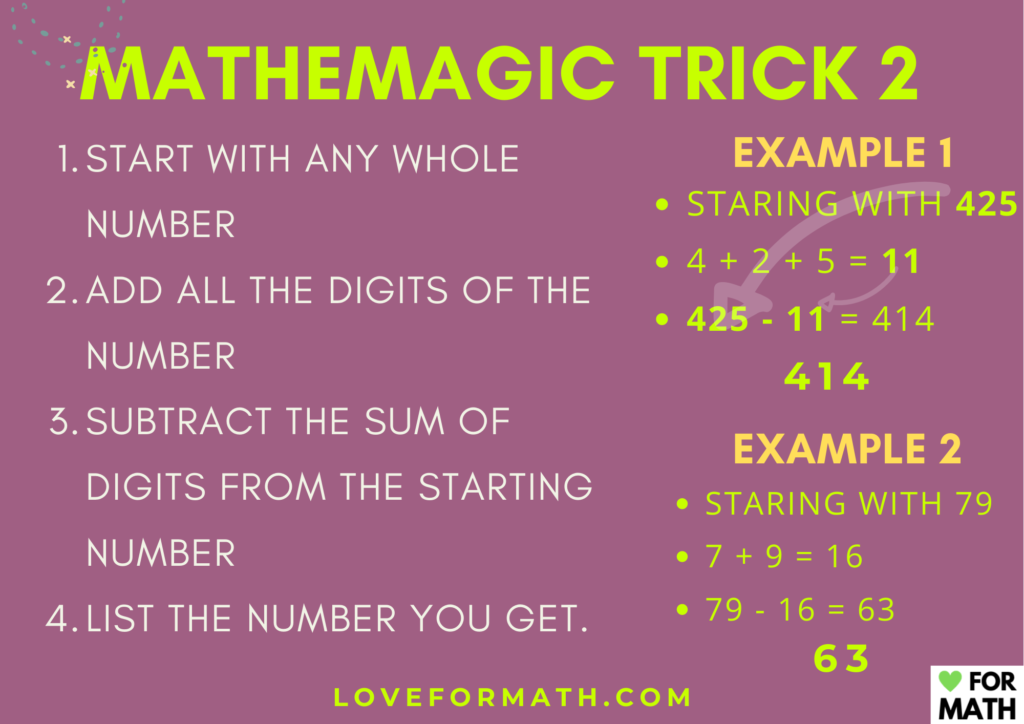
DIY Challenge 2: Try it on ten numbers
Try this for at least 10 numbers. You can start with 2 digit numbers, and then move on to bigger numbers as well.
List down the final answer you get in each case. What are some patterns or anything special you notice about the numbers you get after the 4 steps?
What students worked out12
Student 2
75: ans-63
183: ans-171
9432: ans-9414
12949: ans-12924
idont see any pattern 🙁 🙁 🙁 🙁 🙁 🙁 🙁 🙁 🙁 🙁 🙁Student 2
I think I found a pattern
in 75 and 63 nothing is the same
in 183 and 171 the first digit is the same
in 9432 and 9414 the first 2 digits are the same
in 12949 and 12924 the first 3 digits are the sameKaranteacher
That’s an interesting observation. Why do you think this is happening? We will discuss in the session.
Student 1
I think that if I choose a 1 or 2 or 3 digit number do the following steps you end up with the same amount of digits
Student 2
I don’t think so
Student 4
I found another pattern in Student 2’s numbers…. in 75 and 63, if you subtract 1 from the 1st digit of the first number which is 75, you get 6, the 1st digit of the 2nd number (63). In 183 and 171,the 1st digit in both numbers is the same, but if you subtract 1 from the 2nd digit of the 1st number, you get the 2nd digit of the 2nd number. In 9432 and 9414, first 2 digits are same but if we subtract 2 from the 3rd digit of the 1st number, we get the 3rd number of the 2nd number. Same works for 12949 and 12924, but instead of subtracting 2 from the 3rd number, we subtract from the 4th number as the first 3 digits of both number are the same
Student 11
Sir like Rehan said,
75-63
183-171
9432-9414
12949-12924
These all are multiples of 9Student 14
If you take numbers from 70 to 79, apply trick2 to them, the sums you get can be 63.
Student 12
sir i couldn’t understand it well
Student 3
addition of digits of final answer is always multiplication 9
Student 15
85-13=72
170-17=153
340-34=306
hmmm sir i dont find any patternsStudent 9
They all end in the numbers 4, 9, 2, 3 and 5